

Research has changed significantly with the rise of artificial intelligence. Instead of spending hours searching through websites, reading long documents, and organizing information manually, researchers can now use AI tools to speed up many parts of the research process.
The best AI research tools can help you discover information, summarize documents, understand complex topics, find academic papers, organize notes, and identify useful sources. However, AI should support the research process rather than replace critical thinking and fact-checking.
In this guide, we will explore some of the best AI research tools in 2026 and explain how they can help students, writers, professionals, content creators, and anyone who regularly works with information.
What Are AI Research Tools?
AI research tools are applications that use artificial intelligence to help users search for, understand, analyze, and organize information.
Traditional search engines usually provide a list of links. AI research tools can go further by understanding questions, summarizing information, comparing sources, extracting important points, and helping users organize their findings.
Depending on the tool, you can use AI for tasks such as:
- Finding reliable information
- Discovering research papers
- Summarizing long documents
- Understanding difficult topics
- Comparing different sources
- Extracting important information
- Organizing research notes
- Generating research questions
- Analyzing documents
- Creating research outlines
1. Perplexity
Perplexity is one of the most useful AI-powered research tools for people who want direct answers with supporting sources.
Instead of simply providing a list of search results, Perplexity can generate an answer based on information it finds online and provide references that users can investigate further.
It can be useful for researching current topics, comparing products, exploring industries, and gathering information for articles.
Best for:
- Web research
- Current information
- Source discovery
- Topic exploration
- Quick research summaries
One important habit is to open and verify the sources instead of relying only on the AI-generated answer.
2. ChatGPT
ChatGPT can be useful throughout almost every stage of the research process.
You can use it to brainstorm research questions, explain complicated subjects, create outlines, summarize text you provide, compare ideas, and organize information.
For example, instead of asking AI to simply “do my research,” you can provide a specific research goal and ask it to create a structured research plan.
ChatGPT is particularly useful when you already have research material and want help understanding or organizing it.
Best for:
- Research planning
- Brainstorming
- Summarization
- Explaining complex topics
- Organizing information
Always verify factual claims and important references independently.
3. Google Gemini
Google Gemini can help users research topics, understand information, summarize content, and work with different types of information.
Its integration with Google’s ecosystem can also make it useful for people who regularly work with documents and other productivity services.
Researchers can use Gemini to explore ideas, generate questions, summarize provided information, and develop structured research notes.
Best for:
- General research
- Brainstorming
- Summaries
- Document-based tasks
- Google ecosystem users
4. Elicit
Elicit is designed specifically around research and academic literature.
It can help users discover relevant academic papers and extract useful information from research literature. This makes it particularly valuable for students, academics, and professionals who need to review multiple papers.
Instead of reading every paper from beginning to end before deciding whether it is relevant, researchers can use tools like Elicit to quickly understand the main information and identify papers worth deeper reading.
Best for:
- Academic research
- Literature reviews
- Finding papers
- Research questions
- Paper analysis
5. Consensus
Consensus focuses on finding answers from scientific research papers.
It can be useful when you want to explore what published research says about a particular question. Rather than treating a general web page as evidence, users can use research-focused platforms to discover relevant scientific literature.
Consensus can help researchers get an overview of findings and identify papers that deserve closer examination.
Best for:
- Scientific research
- Academic questions
- Research papers
- Evidence discovery
- Literature exploration
6. NotebookLM
NotebookLM is designed to help users work with their own research materials.
You can provide supported source material and use AI to summarize, explain, organize, and explore that information. This makes it useful when you have collected reports, documents, notes, or other research materials.
One major advantage of source-based research is that you can keep the AI focused on the material you are actually studying.
Best for:
- Document research
- Study materials
- Research notes
- Summaries
- Understanding uploaded sources
7. Semantic Scholar
Semantic Scholar is a research discovery platform that uses AI techniques to help users find and understand academic literature.
It can be useful for students and researchers who need to locate relevant papers without manually searching through thousands of results.
The platform can help users explore academic topics, discover papers, and follow research connections.
Best for:
- Academic papers
- Literature discovery
- Scientific research
- Research topics
- Citation exploration
8. Scite
Scite is designed to help researchers understand how scientific papers are being cited.
Citation information can provide useful context because simply knowing that a paper has been cited does not always tell you whether later research supports or challenges its findings.
Tools that provide citation context can therefore help researchers investigate literature more carefully.
Best for:
- Citation analysis
- Academic research
- Literature reviews
- Scientific papers
- Research verification
9. Claude
Claude can be useful for analyzing large amounts of text and helping researchers organize complex information.
Researchers can use it for summarization, document analysis, brainstorming, writing research outlines, and comparing information from materials they provide.
It can be especially useful when research involves long documents that need to be understood before writing a final report.
Best for:
- Long documents
- Summarization
- Research organization
- Writing support
- Document analysis
10. Wolfram|Alpha
Wolfram|Alpha is different from general AI chatbots because it focuses heavily on computational knowledge and structured data.
For research involving mathematics, statistics, scientific calculations, and quantitative questions, it can be a valuable research companion.
It should not replace primary sources or specialized academic databases, but it can help researchers explore calculations and quantitative concepts.
Best for:
- Mathematics
- Statistics
- Calculations
- Scientific concepts
- Quantitative research
How to Choose the Right AI Research Tool
The best tool depends on the type of research you are doing.
If you need current information from the web, a research-focused search assistant can be useful. For academic papers, platforms such as Elicit, Consensus, and Semantic Scholar may be more relevant.
If you already have documents and need to understand them, NotebookLM or a general AI assistant can be helpful.
Consider these factors before choosing a tool:
1. Research Type
Think about whether you need academic papers, web information, statistics, business information, or document analysis.
2. Source Quality
Check whether the tool provides sources and whether those sources are relevant and trustworthy.
3. Citation Features
For academic or professional work, citation information can be extremely important.
4. Document Support
If you regularly work with PDFs, reports, or large documents, choose a tool that handles your research materials effectively.
5. Privacy
Avoid uploading confidential business information, private documents, or sensitive research materials unless you understand the tool’s data and privacy settings.
How to Use AI for Better Research
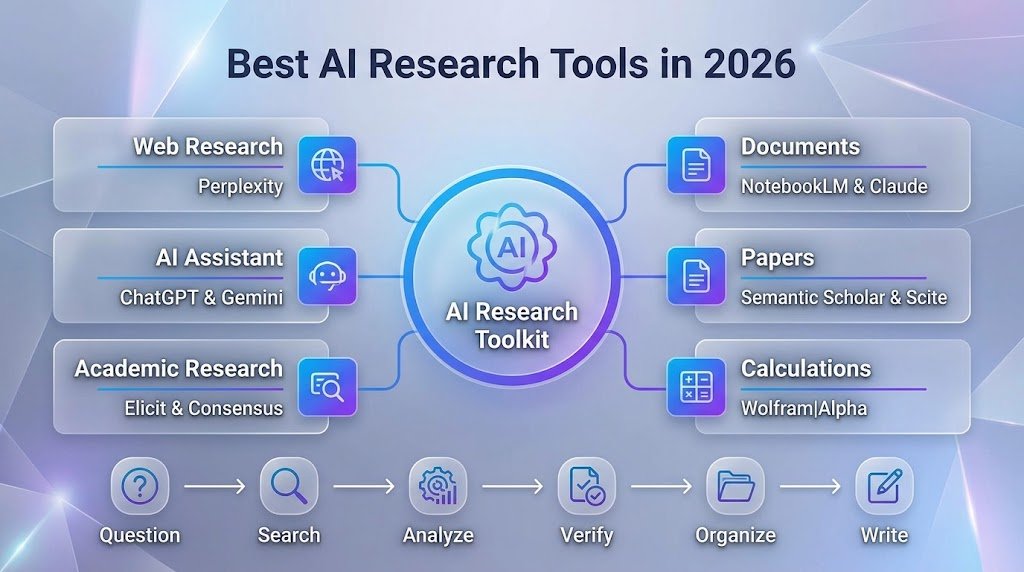
AI can make research faster, but the quality of your results still depends on how you use it.
Start with a clear research question. A specific question usually produces more useful results than a very broad request.
Next, collect information from multiple sources. Don’t depend on a single AI-generated answer.
After gathering information, compare the sources and look for agreements or disagreements. Pay particular attention to claims that could significantly affect your conclusions.
Finally, verify important facts using the original sources.
A simple AI research workflow can look like this:
Research Question → Search → Discover Sources → Summarize → Compare → Verify → Organize → Write
This workflow keeps AI involved while ensuring that the researcher remains responsible for the final information.
Benefits of AI Research Tools
AI research tools can provide several practical benefits.
Save Time
AI can quickly summarize long information and help identify useful sources.
Discover New Sources
Research assistants can help users find papers, websites, and topics they may not have discovered through traditional searches.
Understand Complex Information
AI can explain difficult concepts in simpler language and provide different perspectives on a topic.
Organize Research
Instead of keeping scattered notes, researchers can use AI to create structured summaries and outlines.
Improve Productivity
Researchers can spend less time on repetitive tasks and more time analyzing information and developing ideas.
Limitations of AI Research Tools
AI research tools are powerful, but they are not perfect.
AI systems can sometimes provide incorrect information, misunderstand a question, or present an outdated claim. Some systems may also generate inaccurate references or misunderstand the context of a source.
For this reason, researchers should always verify important claims.
Another limitation is that AI-generated summaries may leave out important details. Reading the original source is still important when the information is critical.
Common Mistakes to Avoid
One common mistake is trusting the first AI-generated answer without checking the evidence.
Another mistake is using only one source. Good research usually involves multiple relevant sources.
Users should also avoid copying AI-generated content directly into academic or professional work without checking accuracy, originality, and citation requirements.
Finally, don’t ask AI to replace your judgment. Use it as a research assistant that helps you work faster and understand information more efficiently.
Final Thoughts
The best AI research tools in 2026 can make research faster, more organized, and easier to manage. Tools such as Perplexity, ChatGPT, Gemini, Elicit, Consensus, NotebookLM, Semantic Scholar, Scite, Claude, and Wolfram|Alpha each serve different research needs.
The key is choosing a tool based on your specific task rather than trying to use one AI platform for everything.
Most importantly, AI should support good research practices. Check sources, compare information, read original material when necessary, and verify important claims before using them.
When combined with human judgment and reliable sources, AI research tools can become powerful assistants for students, professionals, writers, academics, and everyday researchers.
